Your company's fitness programme.Powered by BodyPlan.
The BodyPlan app in your company's name and colours. Every employee gets a personal training plan — not a step count — plus your company challenges and team leaderboards.
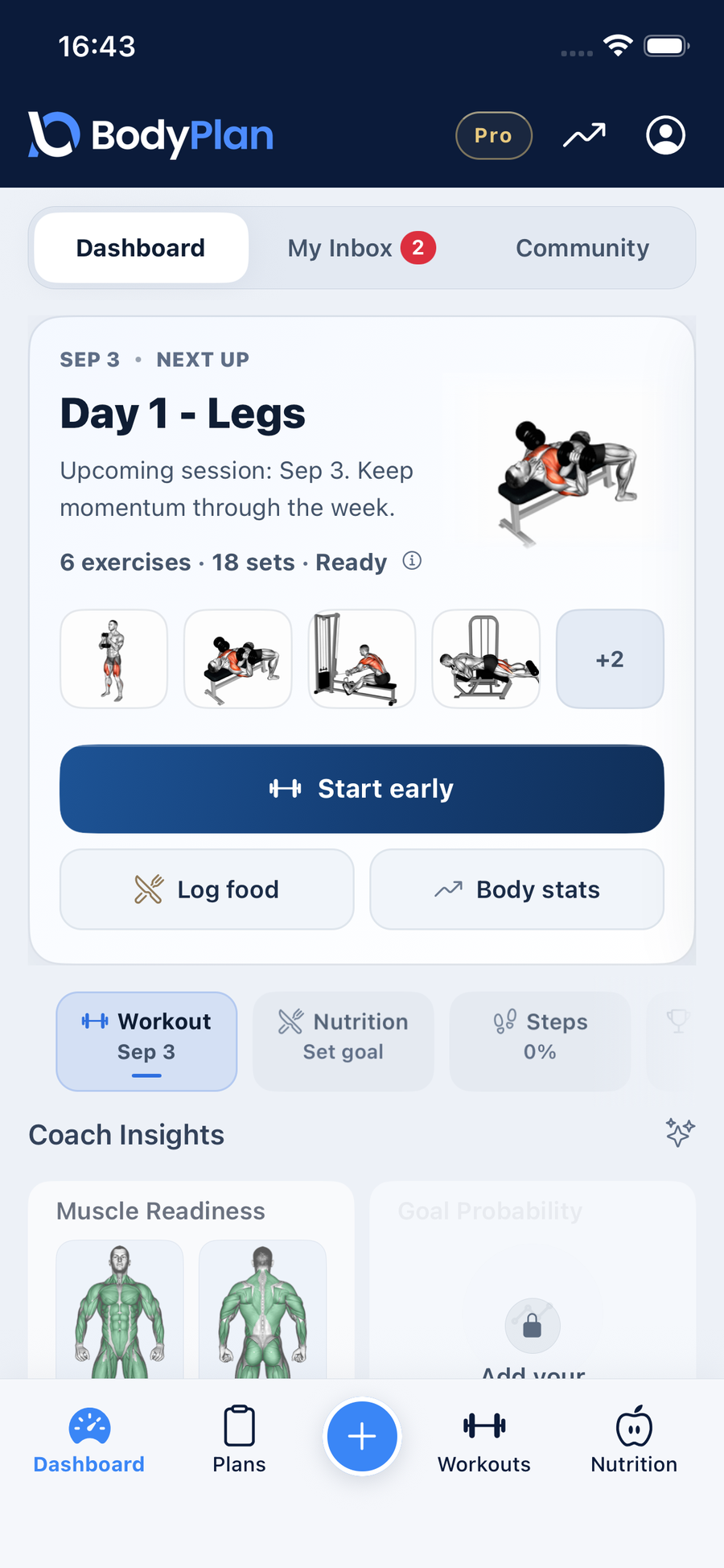
Built for every level, from first session to personal best.
Someone who has never trained and someone who lifts five days a week open the same app and get different programmes, built from their own experience, age, goal, equipment and injuries, and adjusted as they progress. Nobody gets a plan too easy to bother with or too hard to finish.
-
Install
Private enough that they'll join
Their weight, measurements and photos are never visible to you, and the app says so. People sign up when they can see the boundary, not just be promised one.
-
Start
They know what to do on day one
Not a step target — a first session pitched at their level, with named exercises, sets and weights, built around the kit they can reach and the days they can train.
-
Sustain
Competition they can actually win
Small team boards by department, site or shift mean people compete with colleagues they know, not the fittest person in the company. Everyone stays in the race.
And we price on usage, so if your team isn't opening it we don't get paid. See how that works →
Your brand on the outside. Our product on the inside.
Employees open an app with your name on it. Behind that name is a training engine that has to hold its own against everything else on their phone.
Your name on the front, ours as the maker
Your logo, your colours, your company challenges — presented as Your Company, by BodyPlan. The BodyPlan mark stays as the maker's credit, which is what tells a sceptical employee there is a real product behind it.
A programme, written for one person
Goal, experience, injuries, equipment, training days — in, and a structured plan out, with real sets, reps, loads and progression. It adapts as they get stronger.
An app people would choose anyway
People pay for BodyPlan with their own money. Your team gets a full subscription to a product that survives on its own merits — not corporate software with a logo on it.
Competition sized to a team, not a company
Private groups by department, site or shift with their own boards, under company-wide monthly challenges. People compete with the ten colleagues they actually know.
Seat price is not your cost. Cost per active employee is.
A low per-seat price looks cheap on the invoice and usually isn't, because most of those seats go unused. Divide what you spend by the number of people who actually use it, then run the same sum on the calculator below.
We publish a model that charges for real usage rather than headcount precisely because we expect to win that comparison.
Worked example, not a claim about a named competitor. Substitute your own seat price and your own participation rate — the multiple is the point.
Two ways to buy. Both published.
Priced in USD and billed annually. GBP and EUR invoicing available. Minimum 25 employees. Below the crossover in the table, paying per active employee is the cheaper of the two — which for most companies means the active model.
Pay for who uses it
Everyone in the company gets access. You are billed only for the employees who actually used it that month — a workout, a logged meal or an AI feature — with a floor of 25% of headcount so the price stays predictable.
- You stop paying for people who never log in
- Roll out to the whole company with no seat maths
- Our incentive is your usage rate, not your headcount
Whole-company licence
A flat rate per employee on headcount, banded by company size. Choose this when you need a fixed, forecastable line in the budget, or when you expect usage above the crossover for your band.
- One fixed invoice for the year
- Cheaper than the active model above the crossover for your band, published below
- Rate drops automatically at each size band
| Employees | Per employee / month | Annual, at band minimum | Licence wins above |
|---|---|---|---|
| 25–99 | $4.50 | $1,350 | 60% active |
| 100–249 | $3.75 | $4,500 | 50% active |
| 250–499 | $3.00 | $9,000 | 40% active |
| 500–999 | $2.40 | $14,400 | 32% active |
| 1,000+ | Custom | Talk to us | — |
What it would cost you
Corporate wellness platforms commonly settle at 15–25% monthly active. If you know your current figure, use it — the comparison is more useful than the default.
—
—
—
Indicative pricing for planning. Final terms are confirmed in writing before any order. Annual term, billed annually in advance. An employee counts as active in a calendar month if they complete a workout, log a meal, or use an AI feature — plan generation or revision, food lookup, photo meal analysis or body photo estimate. Opening the app or reading a plan does not count. Subject to fair use.
You will never see an individual employee's data.
Not as a policy you have to trust — as a product that cannot show it to you. This is the biggest reason employees refuse to install an employer's fitness app, so we removed the possibility rather than promising restraint.
Health data is special-category data under UK and EU GDPR. Each employee's account is held by BodyPlan as data controller, under our own privacy policy and with their own consent — not by you. The individual health screens stay deliberately unbranded so nobody mistakes them for something their employer is reading.
What an administrator can and cannot see
- Can see: how many people joined, how many are training, and participation trends over time
- Can see: challenge results by team, where a team has at least 8 members
- Never: weight, body measurements, progress photos or body composition
- Never: injuries, health conditions, or anything an employee logged about their body
- Never: a named individual's activity, or any group smaller than 8 people
Run a 90-day pilot before you commit to a year.
Pick one department, site or shift. We set it up, launch a challenge, and report on participation at day 30, 60 and 90. If it doesn't land you have spent $1,500, not an annual budget. If it does, the fee is credited in full against your first invoice.
- Length90 days
- Up to100 employees
- Fee$1,500 flat
- Credited if you continueIn full
- Launch dateAgreed at order
- Notice to stopNone — it just ends
Four steps, and no HR integration to build
-
Verify your domain
We confirm you control your email domain and nominate one administrator. That is the whole of the setup you have to do.
-
Employees join themselves
They install BodyPlan and sign in with a work email. No user list to upload, no accounts to provision, nothing to keep in sync when someone joins or leaves.
-
Launch with a challenge
We set up your first company challenge and the team groups to sit under it. A live competition on day one is what turns an announcement into installs.
-
Report on participation
Aggregate reporting at day 30, 60 and 90 — how many joined, how many are still training, and how that compares to where you started.
Where this works, and where it doesn't
A strong fit
- Emergency services, defence, security and forces-adjacent employers with physical standards to meet
- Construction, trades, logistics and manufacturing, where physical capability is part of the job
- 50 to 1,000 employees, where one person can decide without a six-month procurement cycle
- Distributed, hybrid or multi-site teams who cannot share one gym
Probably not for you
- You want one platform covering mental health, financial wellbeing, benefits and rewards
- You need gym network access rather than training programmes
- You want individual health data reported back to managers — we will not build that
- You need SSO, SCIM provisioning or a formal SOC 2 report today
- Fewer than 25 employees — individual BodyPlan subscriptions will serve you better
Questions procurement will ask
What counts as an active employee?
Can our HR team see an individual employee's data?
What happens to an employee's data when they leave?
Do employees download a separate app?
How long does rollout take?
Is BodyPlan a medical or occupational health service?
Who do we contract with, and where does the data sit?
Tell us about your team
We will come back with a written quote for your headcount and a proposed pilot scope. No call needed unless you want one.